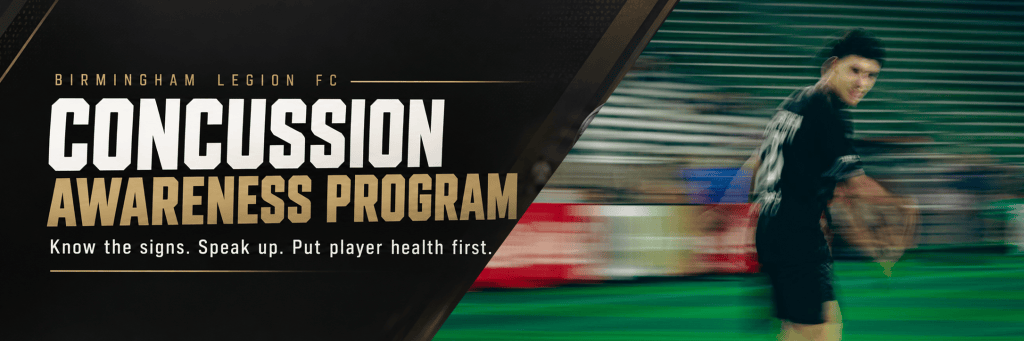
Know the signs. Speak up. Put player health first.
At Birmingham Legion FC, caring for our soccer community extends beyond the pitch. Our Concussion Awareness Program encourages players, parents, coaches, and fans to recognize potential concussions, take symptoms seriously, and support a safer environment for every athlete.
By building awareness and encouraging open conversations about head injuries, we can help players feel confident speaking up—and help those around them know when to act.
Recognize. Report. Respond.
Concussion symptoms can include headaches, dizziness, confusion, nausea, balance problems, and sensitivity to light or noise. Symptoms may develop immediately or take hours or days to appear.
If a concussion is suspected, remove the player from activity immediately and seek evaluation from a healthcare provider. A player with a suspected concussion should never return to play that same day. Returning to sports requires medical clearance and a gradual, supervised process.
Be a Teammate Who Speaks Up
Protecting players takes all of us. Whether you’re on the field, coaching from the sideline, or cheering from the stands, you can help create a culture where reporting symptoms is encouraged and recovery comes first.
No match is more important than a player’s health. Together, we can build a stronger, safer soccer community.
Explore Concussion Safety Resources
If an athlete develops danger signs after an injury—such as seizures, repeated vomiting, a worsening headache, or difficulty waking—call 911 or seek emergency care immediately.
A concussion is a type of Traumatic Brain Injury (TBI) that changes the way the brain normally works. A concussion is caused by bump, blow or jolt to the head or body that causes the head and brain to move rapidly back and forth. Even a “ding,” “getting your bell rung,” or what seems to be a mild bump or blow to the head can be serious. Concussions affect people differently. While most athletes with a concussion recover quickly and fully, some will have symptoms that last for days or even weeks. A more serious concussion can last for months or longer.
Did You Know?
• Most concussions occur without loss of consciousness.
• Athletes who have, at any point in their lives, had a concussion have an increased risk for another concussion.
• Young children and teens are more likely to get a concussion and take longer to recover than adults.